
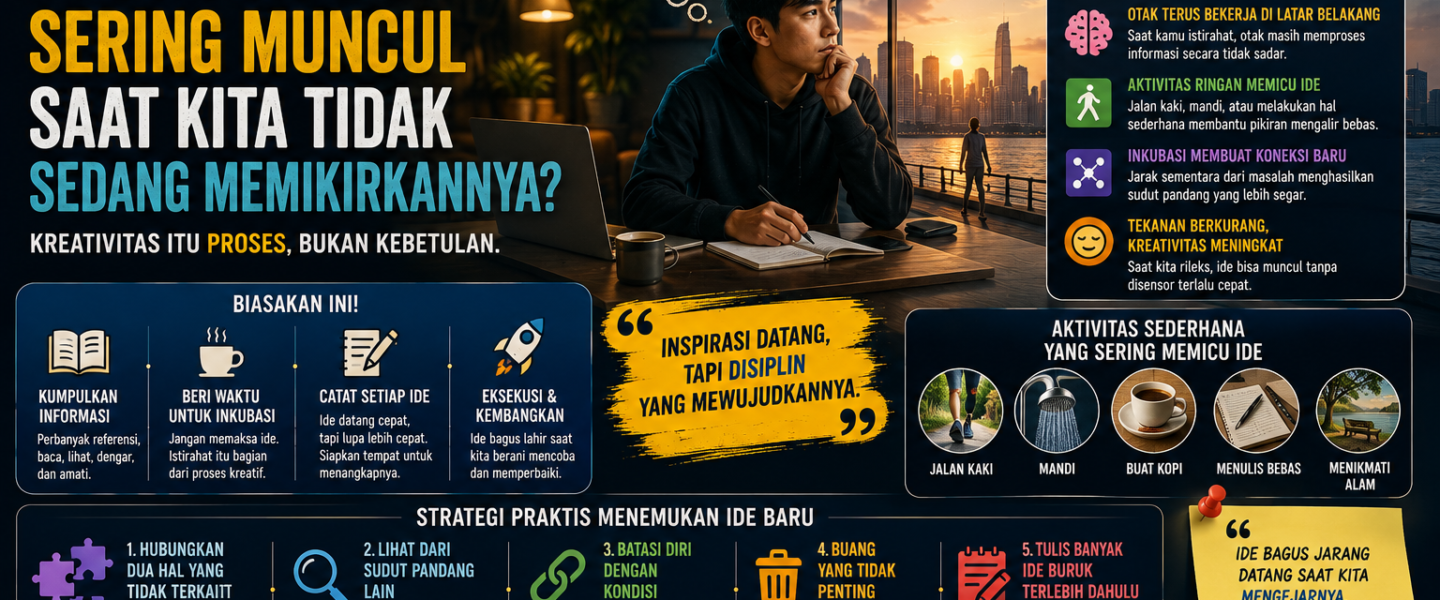
Pernah mengalami ini?
Duduk di depan laptop.
Harus mencari ide.
Sudah 30 menit.
Blank.
Buka notes.
Tidak ada.
Cari referensi.
Semakin banyak lihat:
semakin bingung.
Akhirnya menyerah.
Pergi mandi.
Jalan sebentar.
Buat kopi.
Tiba-tiba:
ide muncul.
Bukan saat kita paling fokus.
Justru saat kita berhenti memaksa otak.
Fenomena seperti ini bukan sekadar kebetulan.
Dalam proses kreatif, ada fase ketika menjauh sementara dari masalah justru membantu otak menemukan connection yang sebelumnya tidak terlihat.
Kreativitas Bukan Hanya “Bakat”
Banyak orang berkata:
“Gue nggak kreatif.”
Seolah kreativitas adalah sesuatu yang dibawa sejak lahir.
Padahal creativity juga melibatkan proses:
mengumpulkan informasi,
menghubungkan ide,
mencoba,
gagal,
dan melihat masalah dari sudut berbeda.
Artinya:
bisa dilatih.
Ide Tidak Muncul dari Ruang Kosong
Kita sering membayangkan creative person duduk.
Boom.
Idea.
Padahal sebelum itu mungkin sudah ada:
bertahun-tahun membaca,
mengamati,
mengerjakan project,
berbicara,
dan mencoba.
Ide baru sering sebenarnya merupakan:
kombinasi baru dari sesuatu yang sudah pernah masuk ke kepala.
Kreativitas Membutuhkan Bahan Baku
Writer butuh:
reading.
Designer butuh:
visual reference.
Musician butuh:
music.
Programmer butuh:
problem exposure.
Kalau input sangat sedikit:
connection yang bisa dibuat juga terbatas.
Tetapi Terlalu Banyak Input Juga Bisa Menghambat
Buka Pinterest.
Behance.
TikTok.
YouTube.
50 reference.
Sekarang semua ide terasa:
“sudah pernah dibuat.”
Overconsumption bisa membuat kita terlalu aware terhadap karya orang lain sampai sulit mendengar ide sendiri.
Input perlu.
Tapi harus ada waktu:
processing.
cara meningkatkan kreativitas
Salah satu cara meningkatkan kreativitas adalah memberi otak kombinasi antara fokus dan ruang kosong. Kumpulkan informasi yang cukup, pahami masalahnya, lalu beri jeda sebelum memaksa solusi muncul. Aktivitas ringan seperti berjalan kaki, mandi, menulis bebas, atau menjauh sementara dari layar dapat membantu otak membentuk hubungan baru di antara informasi yang sebelumnya sudah dipelajari.
Kreativitas tidak selalu lahir dari:
lebih keras berpikir.
Kadang dari:
memberi ruang agar pikiran bekerja dengan cara berbeda.
Ada Fase Inkubasi
Dalam creative problem solving dikenal gagasan mengenai:
incubation.
Kita sudah memikirkan masalah.
Kemudian berhenti sementara.
Saat attention pindah:
processing belum tentu benar-benar berhenti.
Ketika kembali:
solusi terasa muncul tiba-tiba.
Padahal kemungkinan besar otak sudah mengolah material sebelumnya.
“Aha!” Moment Punya Preparation
Shower idea.
Walking idea.
Bedtime idea.
Kelihatannya random.
Tetapi biasanya muncul setelah sebelumnya kita:
terpapar problem.
Kalau tidak pernah memikirkan masalah tersebut sama sekali:
kemungkinan aha moment jauh lebih kecil.
Jadi break bukan pengganti kerja.
Break adalah bagian dari kerja.
Fokus Tetap Penting
Jangan salah interpretasi:
“Berarti kalau mau kreatif, nggak usah kerja.”
No.
Creative process membutuhkan:
focused effort.
Tanpa memahami problem:
otak tidak punya material.
Yang dibutuhkan adalah cycle:
focus → break → return.
Kenapa Memaksa Ide Bisa Membuat Blank?
Saat merasa:
“Harus dapat ide bagus sekarang!”
Pressure meningkat.
Kita mulai mengevaluasi setiap thought terlalu cepat.
Idea baru muncul:
“Jelek.”
Idea kedua:
“Pasaran.”
Idea ketiga:
“Nggak mungkin.”
Akhirnya idea generation mati sebelum sempat berkembang.
Creation dan Evaluation Harus Dipisahkan
Saat brainstorming:
hasilkan.
Saat editing:
nilai.
Kalau dua mode berjalan bersama:
setiap ide langsung disensor.
Creative work butuh permission untuk menghasilkan:
bad ideas.
Bad Ideas Punya Fungsi
Idea buruk bisa mengarah ke:
idea sedang.
Idea sedang bisa memicu:
idea bagus.
Kalau hanya mengizinkan brilliant idea:
nothing comes out.
Quantity membantu menemukan quality.
Brainstorming Tidak Harus Dramatis
Ambil kertas.
Tulis:
20 ide dalam 10 menit.
Aturan:
tidak boleh berhenti.
10 pertama:
obvious.
11–15:
aneh.
16–20:
mulai menarik.
Kenapa?
Karena easy answers sudah habis.
Otak dipaksa keluar dari default.
cara menemukan ide baru
Dalam cara menemukan ide baru, salah satu teknik yang sederhana adalah mengambil dua hal yang awalnya terasa tidak berhubungan lalu mencari titik temu di antara keduanya. Banyak konsep kreatif muncul bukan karena menciptakan sesuatu dari nol, melainkan karena menggabungkan pengalaman, referensi, teknologi, atau sudut pandang yang sebelumnya berada di tempat berbeda.
Contohnya:
coffee shop + library.
fitness + gaming.
travel + history.
music + AI.
Combination creates possibility.
Kreativitas Sering Berarti Recombination
Smartphone?
Phone + computer + camera + internet.
Food delivery app?
Restaurant + map + payment + logistics.
Banyak innovation tidak sepenuhnya baru.
Yang baru:
cara elemen digabungkan.
Analogies Membantu
Masalah bisnis?
Tanya:
kalau ini restoran, bagaimana?
Masalah website?
Kalau ini supermarket?
Analogy memindahkan pattern dari domain lain.
Kadang solusi muncul karena kita keluar dari bahasa problem asli.
Constraint Bisa Meningkatkan Kreativitas
Kedengarannya aneh.
More freedom should mean more creativity.
Tetapi blank canvas unlimited bisa overwhelming.
Constraint membantu.
Contoh:
buat banner hanya dengan:
2 warna.
1 font.
3 elemen.
Sekarang decision space mengecil.
Creativity bekerja di dalam batas.
Budget Terbatas Juga Bisa Memicu Solusi
Tidak bisa beli equipment mahal.
Cari alternative.
Tidak punya team besar.
Automate.
Tidak punya ruang luas.
Design compact.
Constraint memaksa innovation.
Terlalu Banyak Pilihan Bisa Membuat Kita Tidak Memilih
20 font.
50 color palette.
100 layout.
Decision paralysis.
Experienced creator sering justru membuat:
default system.
Sedikit pilihan.
Faster execution.
Boredom Bisa Berguna
Menunggu.
Tidak buka phone.
Awalnya:
gelisah.
Kemudian pikiran mulai wandering.
Memikirkan hal random.
Menghubungkan memory.
Inilah ruang yang semakin jarang kita punya.
Smartphone Mengisi Semua Ruang Kosong
Lift.
Queue.
Toilet.
Bus.
Bed.
Setiap 30 detik kosong:
screen.
Artinya otak hampir tidak pernah:
idle.
Padahal mind wandering punya role dalam creative thought.
Coba Jalan Tanpa Headphone
15 menit.
No podcast.
No music.
No notification.
Just walk.
Awalnya terasa boring.
Kemudian pikiran mulai bergerak.
Banyak orang mendapatkan ide saat walking karena:
movement + low cognitive demand + no screen.
Walking Punya Hubungan Klasik dengan Thinking
Banyak writer dan thinker historically suka berjalan.
Tidak harus mystical.
Saat berjalan:
body active.
attention cukup bebas.
environment berubah.
Itu kondisi bagus untuk associative thinking.
Tetapi Jangan Paksakan “Creative Walk”
Kalau setiap langkah berpikir:
“Mana ide? Mana ide?”
Pressure kembali.
Just walk.
Biarkan thought muncul.
Bawa Notes
Karena masalah terbesar shower idea adalah:
lupa.
Satu jam kemudian:
“Td ide gue apaan ya?”
Capture quickly.
Phone notes.
Voice memo.
Small notebook.
Jangan Percaya Memory
Idea feels unforgettable.
Usually isn’t.
Write.
Even one sentence.
Idea Capture Harus Cepat
Kalau system notes terlalu rumit:
folder.
tag.
database.
category.
Kita malas mencatat.
Capture first.
Organize later.
One Inbox for Ideas
Satu tempat.
Notes app.
Notion page.
Telegram saved message.
Notebook.
Whatever.
Avoid 10 different apps.
Idea Bank Bisa Menjadi Asset
Writer:
headline ideas.
Designer:
layout references.
Business:
problem observations.
Content creator:
hooks.
Over months:
hundreds of seeds.
Now blank page is less blank.
Tetapi Jangan Hanya Mengumpulkan
1000 saved posts.
Never create.
That’s consumption hoarding.
Rule:
for every X references:
make something.
Inspiration Harus Berakhir di Output
Reference → interpretation → creation.
Kalau berhenti di reference:
bukan creative process.
Copying vs Learning
Beginner sering belajar dengan imitation.
Study structure.
Recreate technique.
Tetapi jangan publish plagiarism.
Use imitation as exercise.
Then transform.
Originality Itu Spektrum
Almost nothing exists in complete isolation.
Originality often means:
unique combination,
unique perspective,
unique execution.
Tidak perlu pressure menjadi 100% unprecedented.
“Sudah Pernah Ada” Tidak Berarti Jangan Buat
Sudah ada coffee shop.
Still new coffee shops open.
Sudah ada travel blog.
Still can create one.
Difference can be:
audience.
style.
timing.
quality.
angle.
Execution Often Matters More Than Raw Idea
Great idea.
Never executed.
Value:
zero.
Average idea.
Excellent execution.
Can become great.
Don’t worship ideation.
Creative People Ship
Draft.
Prototype.
Test.
Publish.
Feedback improves next idea.
Creative skill grows through output.
Perfectionism Membunuh Volume
Setiap project harus masterpiece.
Result:
2 projects/year.
Someone else:
50 projects.
Which person learns more?
Usually the one with more feedback cycles.
Version 1 Is Research
Launch small.
Observe.
Improve.
This mindset lowers fear.
Creativity Needs Feedback
Writer can’t know if explanation works until reader reads.
Designer needs user.
Product needs customer.
Closed-room creativity has limits.
But Too-Early Feedback Can Kill Fragile Ideas
New concept barely formed.
Show to 10 people.
“Meh.”
Kill it.
Sometimes idea needs development before external judgment.
Timing matters.
Protect Early Stage
First:
explore privately.
Then:
test.
Not Everyone Should Review Your Work
Ask:
relevant audience.
mentor.
user.
Random friend may not understand goal.
Feedback quality matters.
“I Don’t Like It” Is Weak Feedback
Ask:
what specifically?
Confusing?
Boring?
Too long?
Wrong tone?
Specificity makes feedback useful.
Separate Taste from Function
“I don’t like blue.”
But target users respond well.
Personal taste isn’t objective failure.
Creative work often serves goal.
Data Can Support Creativity
A/B test.
Engagement.
User behavior.
Search data.
But don’t let metric replace judgment completely.
Data tells:
what happened.
Not always why.
Algorithm Can Narrow Creativity
Creator sees:
video style A gets views.
Repeat.
Repeat.
Repeat.
Eventually everything same.
Optimization can reduce experimentation.
Keep a Percentage for Experiments
80% proven format.
20% weird.
Something like that.
Safe base + exploration.
Explore vs Exploit
In decision science:
exploit known good option.
Explore new options.
Creative work needs both.
Only explore:
chaos.
Only exploit:
stagnation.
Curiosity Is Fuel
Ask:
why?
what if?
why not?
how does that work?
Curious people collect unusual inputs.
Unusual inputs create more combinations.
Read Outside Your Field
SEO person reads architecture.
Designer reads psychology.
Writer reads biology.
Cross-domain knowledge creates fresh analogies.
Specialist + Generalist Balance
Depth gives competence.
Breadth gives connections.
Creative advantage can come from being:
deep enough somewhere,
curious everywhere.
Travel Can Increase Creativity
New city.
New language.
Different transport.
Different food.
Assumptions challenged.
Novel environment gives new input.
But travel isn’t required.
Explore Your Own City Differently
Take different route.
Visit museum.
Go to neighborhood never visited.
Novelty can be local.
Change Physical Workspace
Coffee shop.
Library.
Different room.
Even moving desk.
Environment cues change thinking slightly.
But Don’t Turn Workspace Optimization Into Procrastination
New keyboard.
Desk.
Lamp.
Notion template.
Still no work.
Environment helps.
Doesn’t create output itself.
Music Can Help or Hurt
Instrumental music:
helps some.
Lyrics:
distract some.
Silence:
best for others.
No universal creative playlist.
Test.
White Noise
Cafe noise.
Rain.
Brown noise.
People use these for focus.
Effect varies.
Use if helpful.
No magic frequency.
Deep Focus Helps Complex Creation
Writing structure.
Coding.
Design problem.
Need uninterrupted time.
Creative insight and execution are different.
Insight may come walking.
Execution needs focus.
Protect Creation Time
90 minutes.
Phone away.
No email.
One project.
Large blocks allow context buildup.
Context Switching Is Expensive
Write 5 minutes.
Reply chat.
Write.
Instagram.
Write.
Each switch reloads mental model.
Creative depth suffers.
Notifications Break Fragile Thought
Idea forming.
Ping.
Gone.
Silence matters.
Create Before Consume
Morning.
Instead of feed first:
write 20 minutes.
This protects original thought before others’ ideas flood head.
Creator Mode vs Consumer Mode
Consumer:
take in.
Creator:
produce.
Both needed.
But if consumer mode occupies all day:
no output.
Set Ratio
Maybe:
1 hour learning.
2 hours making.
Depends work.
Just be conscious.
Research Has a Stop Point
Writer can research forever.
Eventually:
draft.
Set:
research deadline.
Then create with current information.
Unknowns Can Be Marked
Don’t stop entire draft because one fact missing.
Write:
[CHECK DATA].
Continue.
Momentum preserved.
Creativity Loves Momentum
Once moving:
ideas connect.
Starting is hardest.
Use Ugly First Draft
No format.
No edit.
No judging.
Just material.
Later sculpt.
Sculptor Analogy
First draft gives stone.
Editing creates shape.
No stone?
Nothing to sculpt.
Editing Is Creative Too
Removing.
Reordering.
Simplifying.
Good creativity isn’t only adding.
Often subtraction.
Constraints Through Subtraction
Can this sentence disappear?
Feature?
Color?
Scene?
Minimalism can require more creativity than adding everything.
Simplicity Is Hard
Complex idea explained simply:
requires understanding.
Simple doesn’t mean shallow.
Creativity and Clarity Can Coexist
Weird for weird’s sake:
not always good.
If audience doesn’t understand:
creative communication failed.
Surprise + Familiarity
Many successful ideas combine:
something recognizable
with
something unexpected.
Too familiar:
boring.
Too weird:
confusing.
Balance.
Example
Normal coffee cup.
But shaped like camera lens.
Familiar + twist.
Humor Works Similarly
Setup familiar.
Punchline unexpected.
Creative structure appears everywhere.
Pattern Recognition Can Be Trained
Study why things work.
Ad.
Film.
Article.
Website.
Don’t just say:
“bagus.”
Ask:
why?
Reverse Engineer
What is hook?
Structure?
Contrast?
Pacing?
Hierarchy?
Then apply principle elsewhere.
Don’t Copy Surface Only
See viral design.
Copy colors.
Miss underlying reason:
clear hierarchy.
Learning principle > copying appearance.
Build Taste
Taste grows through exposure to great work.
But taste can exceed skill.
Beginner sees work is bad.
Can’t fix yet.
Frustrating.
Keep practicing.
Ira Glass Gap
There is a common creative concept: beginners often have good taste but current skill can’t yet produce work matching it.
The solution:
volume.
Not quitting.
Practice Specific Weakness
Designer weak typography?
Make 20 typography exercises.
Writer intros weak?
Write 50 intros.
Targeted repetition.
Deliberate Creativity Training
Not just “make more.”
Identify component.
Practice.
Feedback.
Repeat.
Idea Generation Can Be Scheduled
Some think creativity only when inspiration hits.
Professional creators can’t wait.
Deadline.
Client.
Publication.
Need system.
Scheduled Creativity Sounds Contradictory
But showing up increases probability inspiration appears.
Writer sits daily.
Not every session brilliant.
Enough sessions produce material.
Inspiration Likes Prepared People
You can’t order lightning.
But you can stand outside more often.
Routine Can Support Creativity
Same time.
Same place.
Brain associates cue with creative work.
Routine reduces startup decision.
Novelty Still Needed
Too much routine:
stale.
Add:
new input.
new project.
new constraint.
Creative Burnout Is Real
Output nonstop.
No input.
Ideas dry.
Rest isn’t laziness.
It’s replenishment.
Sleep Is Creative Infrastructure
Sleep supports:
memory consolidation,
problem solving,
emotion regulation.
All-nighter can produce output.
Long-term poor sleep hurts creativity.
Dream Ideas
Sometimes idea appears after waking.
Dream states create unusual associations.
Keep notes near bed if useful.
But most dreams are not masterpieces.
Don’t romanticize every one.
Rest Days Can Improve Work
Distance reveals flaws.
Return to design after weekend:
“Why is this huge?”
Fresh eyes.
Incubation Can Be Hours or Days
Stuck on problem?
If deadline allows:
leave overnight.
Return.
Often easier.
But Don’t Use Incubation as Excuse
“I’m incubating.”
Three weeks.
No work.
Need initial focused effort first.
Define Problem Clearly
Creative solution depends on problem framing.
“Need better website.”
Vague.
“Users can’t find checkout button.”
Specific.
Now ideas targeted.
Spend Time on Problem Definition
Einstein is often associated with idea that defining problem matters enormously, though internet quotes vary.
Regardless of attribution:
problem framing matters.
Ask Five Whys
Sales low.
Why?
Traffic low.
Why?
Ranking dropped.
Why?
Technical issue.
Why?
Site changed.
Now actual problem different.
Reframe
“How do we make customers buy?”
vs.
“How do we make product easier to choose?”
Different creative direction.
Question Assumptions
“Banner needs model.”
Does it?
“Article must be 2000 words.”
Why?
“Office needs desks.”
Maybe.
Assumption removal opens options.
List Constraints Explicitly
Budget.
Time.
Audience.
Medium.
Brand.
Then distinguish:
real constraints
vs
assumed constraints.
“We Always Do It This Way”
Classic creativity killer.
Ask why.
Maybe good reason.
Maybe inertia.
Beginner’s Mind
Expertise gives shortcuts.
But shortcuts can create blind spots.
Imagine seeing problem for first time.
What would feel weird?
Ask Outsider
Someone outside field may ask “stupid” question that exposes assumption.
Don’t dismiss instantly.
Childlike Questions Can Be Powerful
Why can’t cars be rented by minute?
Why need hotel reception?
Why buy album instead of single song?
Many innovations start with obvious-sounding question.
But Not Every Crazy Idea Is Innovation
Need feasibility.
User value.
Economics.
Creativity + reality.
Divergent Then Convergent Thinking
Phase 1:
many possibilities.
Phase 2:
select.
Mixing too early reduces exploration.
Never selecting creates chaos.
Both necessary.
Use Criteria for Selection
Impact.
Cost.
Time.
Risk.
Originality.
Fit.
Score ideas.
Now selection less emotional.
Don’t Pick Favorite Because It Was Yours
Team brainstorm.
Your idea.
Attachment.
Danger.
Judge against criteria.
Anonymous Idea Review Can Reduce Ego
If possible.
Idea separated from author.
Psychological Safety Improves Creativity
People need freedom to say:
weird idea.
Without mockery.
If manager laughs:
people stop contributing.
“Yes And”
From improv.
Build idea before criticizing.
Not always final decision.
But useful during divergent phase.
“No Because” Comes Later
Evaluation phase.
Group Brainstorming Has Problems Too
Loud people dominate.
Ideas anchor each other.
Better:
individual brainstorm first.
Then group.
More diversity.
Brainwriting
Everyone writes ideas silently.
Then share.
Useful for introverts and reducing conformity.
Remote Teams Can Use Async Ideation
Give 24 hours.
People think at different times.
Then review.
Not every creative problem needs meeting.
Meeting Can Kill Deep Thought
“Let’s brainstorm 9 AM.”
Some people need preparation.
Send problem before meeting.
Creative Brief Should Be Clear
Objective.
Audience.
Message.
Constraints.
Deliverable.
Without brief:
feedback becomes subjective chaos.
“Make It Pop” Is Not a Brief
Need specifics.
More contrast?
More energy?
Younger audience?
Clarify.
Good Question to Client
“What should audience feel/do after seeing this?”
Now design has purpose.
Creative Quality Isn’t Just Beauty
Ad must sell.
Article must explain.
UX must work.
Purpose defines quality.
Function and Aesthetic
Best work often merges both.
Beautiful but unusable:
problem.
Functional but ugly:
sometimes okay.
Goal dependent.
Iteration Beats Debate
Team arguing 2 hours about button.
Make two versions.
Test.
Prototype resolves abstract debate.
Prototype Cheaply
Sketch.
Wireframe.
Mockup.
Draft.
Don’t polish unvalidated idea.
Fail Cheap
Early failure:
good.
Late failure after huge investment:
bad.
Creativity should reduce uncertainty early.
Experiment Is Creativity with Feedback
Hypothesis.
Make.
Test.
Learn.
Creative Confidence Comes from Surviving Bad Ideas
After enough projects:
you know one bad draft isn’t fatal.
This reduces fear.
Fear of Looking Stupid Blocks Innovation
Every unusual idea can sound stupid initially.
Environment needs tolerance.
But Courage Doesn’t Mean Ignoring Criticism
Listen.
Assess.
Improve.
Failure Portfolio
Look back at failed ideas.
What did they teach?
Some may be reusable in new context.
Dead Ideas Can Return
Wrong timing.
Wrong audience.
Technology wasn’t ready.
Years later:
viable.
Keep archive.
Technology Changes Feasibility
Idea impossible 2010.
Easy 2026.
Revisit old problems.
Creativity Often Follows Tool Change
Camera phone created:
Instagram.
Cheap video editing created creators.
Generative AI creates new workflows.
Tools open spaces.
But Tool Isn’t Idea
Using AI doesn’t make output creative automatically.
Prompting same generic thing:
generic output.
Creative direction still matters.
AI Can Expand Ideation
Generate variants.
Counterarguments.
Names.
Outlines.
Moodboards.
Useful.
AI Can Also Homogenize
If everyone uses same model for same prompt:
outputs converge.
Human taste and editing become differentiator.
Use AI as Partner Not Autopilot
Ask for:
20 possibilities.
Then curate.
Combine.
Rewrite.
Human context adds uniqueness.
Original Data Gives Unique Content
Interview.
Personal experience.
Experiment.
Survey.
Photography.
These are harder to commoditize than generic summaries.
Unique Inputs → Unique Outputs
If everyone reads same 3 articles:
content same.
Broaden sources.
Observation Is a Creative Skill
Notice:
customer complaint.
weird sign.
friction.
habit.
Good ideas often begin with noticing.
Keep Problem Journal
“What annoyed me today?”
Slow checkout.
Cable mess.
App confusing.
Each annoyance could become idea.
Innovation Often Solves Friction
People hate:
waiting.
remembering.
carrying.
searching.
paying complicatedly.
Find friction.
Jobs to Be Done
Customer doesn’t buy drill because wants drill.
Wants hole.
Classic concept.
Understand underlying job.
Creative solution may not resemble existing product.
Ask “What Are They Really Trying to Do?”
Travel website visitor:
not trying to read 3000 words.
Trying to decide itinerary.
Now content structure changes.
Empathy Supports Creativity
Understand user.
Not assume.
Interview.
Observe.
But Users Don’t Always Know Solution
They know problem.
Designer translates.
Famous “faster horse” quote often misattributed to Henry Ford; regardless, principle:
ask needs, not only requested feature.
Combine User Insight + Technical Possibility
That’s fertile innovation zone.
Serendipity
Unexpected discovery.
Penicillin is classic example in science.
But serendipity favors observation.
Many people could see anomaly.
Creative person asks:
what is this?
Don’t Optimize Away All Randomness
Recommendation algorithms give more of same.
Occasionally browse random book section.
Talk to different people.
Random inputs create connections.
Random Word Technique
Problem:
need content idea.
Open dictionary:
“bridge.”
Ask:
how does bridge relate?
Maybe article about connecting generations.
Simple creativity exercise.
SCAMPER
Substitute.
Combine.
Adapt.
Modify.
Put to another use.
Eliminate.
Reverse.
Framework for modifying existing idea.
Useful when stuck.
Reverse Thinking
Instead of:
“How to make users happy?”
Ask:
“How would we make users hate this?”
List:
slow site.
confusing menu.
hidden price.
Then reverse each.
Sometimes easier.
Worst Possible Idea
Ask team:
what’s worst solution?
Laughter.
Pressure lowers.
Bad idea can contain interesting seed.
10x Question
What if solution had to be:
10x faster?
10x cheaper?
Forces rethink architecture.
Half-Time Constraint
Need finish in half time.
What would you remove?
Priorities emerge.
Zero-Budget Constraint
How would you solve without money?
May uncover process solution.
Abundance Constraint
What if budget unlimited?
Reveals ideal solution.
Then scale down.
Different Perspective
How would:
child,
engineer,
artist,
competitor,
customer
solve?
Perspective shift.
Future Backward
Imagine it’s 2030 and solution succeeded.
What happened?
Work backward.
Pre-Mortem for Creativity
Imagine project failed.
Why?
Boring?
Too expensive?
Wrong audience?
This improves execution before launch.
Constraints Can Be Self-Imposed
Writer:
no adjectives.
Designer:
black/white only.
Photographer:
one lens.
Exercises build range.
Practice With Limits Then Remove Them
Skill increases.
Creativity and Discipline Are Partners
Idea without discipline:
unfinished.
Discipline without creativity:
repetitive.
Need both.
Build System That Captures Inspiration and Executes Regularly
Idea bank + calendar.
Simple.
Weekly Creative Review
What made?
What learned?
What inspired?
What stuck?
What to try next?
Keep Portfolio of Experiments
Not only final polished work.
Track growth.
Compare to Yourself
Old work.
Current work.
Progress visible.
Comparing constantly to top professionals demotivates.
But Study Masters
Analyze.
Don’t only admire.
Borrow Principles Across Eras
Old print poster.
Modern web.
Typography principles still useful.
Technology changes.
Human perception less quickly.
History Is Creative Reference
Fashion cycles.
Design trends return.
Music samples.
Old ideas become new through context.
Nostalgia Is Recombination Too
Retro aesthetics + modern technology.
Common successful formula.
Culture Provides Creative Material
Local slang.
Tradition.
Architecture.
Food.
But avoid shallow appropriation.
Understand context.
Authenticity Comes from Specificity
Generic:
“a beautiful city.”
Specific:
“tram bell at 7 AM in Wan Chai.”
Specific detail creates voice.
Creative Writing Loves Concrete Detail
Show object.
Sound.
Smell.
Not only abstract adjective.
Sensory Input Feeds Creative Memory
Go outside.
Observe.
Screen isn’t entire world.
Nature Can Reset Attention
Park.
Forest.
Ocean.
Even 20 minutes.
Less stimulus.
Useful mental reset.
Creative Retreat Doesn’t Need Bali Villa
Cafe afternoon.
Phone off.
Notebook.
That’s enough.
Schedule Empty Time
Counterintuitive.
Calendar:
nothing.
Let mind wander.
Without protected space, every gap gets consumed.
But Empty Time Can Feel Unproductive
Trust process.
Not all work is visible.
Creative Work Has Hidden Phases
Input.
Incubation.
Insight.
Execution.
Editing.
Presentation.
Only execution looks like work to outsiders.
Respect Incubation but Track Deadline
Balance.
Deadlines Can Increase Creativity Up to a Point
Constraint energizes.
Too much pressure narrows thinking.
Optimal challenge.
Yerkes-Dodson Type Principle
Performance may improve with moderate arousal, then decline when stress too high.
Not specific only to creativity, but useful.
Reduce Stakes for Early Draft
“This is experiment.”
Less anxiety.
Play Is Important
Try tool with no client goal.
Doodle.
Write nonsense.
Experiment.
Play produces unexpected skill.
Adults Lose Playfulness
Everything needs ROI.
But creative exploration often has no immediate outcome.
Give some room.
Hobby Can Feed Professional Work
Photography hobby improves composition.
Gaming inspires UX.
Cooking teaches iteration.
Nothing wasted.
Multidisciplinary Hobbies Are Creative Cross-Pollination
Learn outside career.
Don’t Monetize Every Hobby
Sometimes making hobby work destroys play.
Keep some things just for fun.
Creativity Needs Emotional Safety
Constant self-criticism:
reduces experimentation.
Treat draft as draft.
Inner Critic Has a Job, Just Not During Brainstorm
Schedule critic later.
Name Modes
Explorer.
Builder.
Editor.
Different mental roles.
Useful cue.
Explorer Asks “What If?”
Builder asks “How?”
Editor asks “Is This Good?”
Don’t ask all three simultaneously.
Creative Block Might Be Decision Block
Too many choices.
Pick one constraint.
Proceed.
Or Knowledge Gap
Don’t know enough.
Research.
Or Energy Problem
Sleep.
Rest.
Or Fear Problem
Lower stakes.
Diagnose Before Forcing
“Creative block” isn’t one thing.
Keep Deadline Visible
Sometimes block is avoidance.
Need accountability.
Body Influences Mind
Exercise.
Sleep.
Food.
Movement.
Brain is not detached.
Exercise May Support Cognition
No need turn gym into creativity hack.
But general health supports mental performance.
Hydration Too
Basic.
Still matters.
Caffeine Can Help Focus But Not Replace Sleep
Coffee isn’t personality.
Use sensibly.
Alcohol and “Creative Genius”
Romanticized.
Intoxication may lower inhibition but harms judgment and has broader risks.
Not a creativity requirement.
Great Work Mostly Comes from Revisions
First spark gets glory.
Editing does heavy lifting.
Revision Creates Originality
Generic first idea.
Refine.
Add specificity.
Combine.
Now yours.
Ask “What’s the Obvious Version?”
Write it.
Then ask:
what’s less obvious?
First Idea Often Belongs to Culture
Because it’s most available.
Push further.
20-Idea Rule Useful Again
Volume.
Creativity Is Statistical
More attempts:
more chance one is excellent.
But Learn from Attempts
Random volume without feedback:
less growth.
Ship Small Frequently
Article.
Poster.
Prototype.
Don’t Wait for Magnum Opus
Career built from body of work.
Creative Identity Should Be Verb
Not:
“I am creative.”
But:
“I create.”
Action.
If You Feel Uncreative, Make Something
Evidence changes identity.
Ten Minutes Counts
Creative session doesn’t need whole day.
Capture Tiny Ideas
Headline.
Sketch.
Melody.
Later combine.
Creativity Compounds
One idea leads another.
Portfolio grows.
Skill grows.
Network grows.
Opportunities grow.
Long-Term Consistency Beats Occasional Inspiration
Professional truth.
Algorithm Changes, Creative Fundamentals Stay
Attention.
clarity.
emotion.
story.
problem solving.
Trend Awareness Is Useful but Don’t Chase All Trends
By time copied:
trend saturated.
Use trend as ingredient.
Not identity.
Timeless + Timely
Strong content often combines evergreen insight with current context.
Learn to Say No to Ideas
Too many good ideas can be problem.
Pick.
Idea Opportunity Cost
Working on A means not working B.
Prioritize.
Use “Idea Parking Lot”
Not now.
Not lost.
Reduces FOMO.
Finish Before Starting Five More
WIP limit.
Kanban principle useful creatively.
Completion Teaches Final 20%
Packaging.
Export.
Publish.
Feedback.
People who never finish miss these skills.
Creative Career Requires Boring Skills
File management.
Email.
Deadline.
Backup.
Invoice.
No glamour.
Still essential.
Organize Assets
Future you thanks you.
Name Files Properly
final_final_v7_REAL.psd
We’ve all been there.
Version system.
Backup Creative Work
Ideas aren’t useful if drive dies.
Cloud + local.
Archive Old Versions
Sometimes rejected concept becomes useful.
But Don’t Hoard Every Gigabyte Forever
Clean periodically.
Protect Source Files
Final JPEG isn’t editable source.
Documentation Helps Teams
Why decision made.
Brand rules.
Reusable knowledge.
Creativity at Organization Level Needs Memory
Otherwise same mistakes repeat.
Post-Mortem
What worked?
What didn’t?
Store learning.
Creative Culture Rewards Experiments, Not Only Wins
If failure punished every time:
nobody experiments.
Leadership Sets Tone
Manager asks for innovative idea then rejects anything unfamiliar:
innovation dies.
Give Clear Risk Boundaries
“You can experiment within X.”
Safety + freedom.
Creative Collaboration Requires Trust
People share half-formed ideas only if safe.
Credit Matters
Acknowledge contributions.
Stealing ideas destroys collaboration.
Combination Doesn’t Mean Ownership Theft
Give credit.
Ethics supports creative ecosystem.
Inspiration Sources Should Be Documented
Especially professional design.
Avoid accidental plagiarism.
Similarity Can Happen
If concerned:
compare.
Transform more.
Trademark/Copyright Considerations
Creative work still operates under legal constraints.
Originality also protects risk.
AI Raises New Questions
Source.
style imitation.
rights.
Disclosure.
Use responsibly.
Creativity Is Human Context + Tools
Tools change.
Need remains:
solve meaningful problem.
The Best Idea Isn’t Always the Most Complex
Often simplest idea people remember.
Memorability Comes from Clear Core
Can you explain in one sentence?
If not:
maybe idea still muddy.
“One Sentence Test”
This project is:
___ for ___ so they can ___.
Clarifies.
If Team Describes Project Differently, Alignment Problem
Fix before design.
Naming Is Creative Compression
Good name communicates concept compactly.
Hard.
Headlines Too
One line must earn attention.
Practice headline writing separately.
Curiosity Gap Without Clickbait
Promise meaningful information.
Deliver.
Trust.
Creative Trust Compounds
Audience learns:
your headline worth clicking.
Don’t burn trust for short-term attention.
Novelty Gets Click, Value Gets Return
Both matter.
Creative Work Is Communication
Even art communicates emotion.
If no one receives intended signal, reflect.
Audience Interpretation Can’t Be Fully Controlled
Different backgrounds.
That’s okay.
Leave Some Space for Interpretation
Not every artwork needs explanation.
But informational content needs clarity.
Context Determines Degree of Ambiguity
Safety instructions:
zero ambiguity.
Poetry:
ambiguity can be feature.
Creativity Is Contextual
No universal “most creative.”
A creative tax form might simply be easier.
Innovation Can Be Invisible
Better process.
Fewer clicks.
Smaller file.
Users may not notice.
Still creativity.
Maintenance Is Creative Too
Improve old system.
Not only new shiny things.
Subtraction Innovation
Remove feature.
Remove step.
Remove confusion.
Powerful.
Ask “What Can We Stop Doing?”
Great creative question.
Legacy Process Often Accumulates
Meeting because always meeting.
Report nobody reads.
Remove.
Automation Frees Creative Energy
Automate repetitive tasks.
Use time for judgment.
But Automating Bad Process Makes Bad Process Faster
Fix process first.
Technology Should Reduce Friction Not Add Complexity
Tool sprawl harms.
One Tool Well Used > Ten Tools Poorly Used
Creativity Doesn’t Require Expensive Tools
Pencil.
Notes app.
Cheap camera.
Idea quality independent of price.
Better Gear Helps Certain Execution
But use current gear until bottleneck real.
Gear Acquisition Syndrome Is Procrastination Cousin
Buying feels like progress.
Create first.
Constraints of Cheap Gear Can Teach Skill
Lighting.
Composition.
Technique.
Upgrade When You Know Why
Specific limitation.
Not vague desire.
Creative Envy Can Be Useful
See work.
Feel jealous.
Ask:
what specifically do I want?
Skill?
Audience?
Style?
Resources?
Turn envy into data.
Don’t Copy Their Life
Trade-offs unseen.
Social Media Distorts Creative Success
You see:
viral project.
Not 100 failed posts.
Survivorship bias.
Build Your Own Pace
Long game.
Breaks from Social Media Can Restore Taste
Too much trend exposure homogenizes ideas.
Offline input.
Books.
Places.
People.
Read Old Books
Less algorithmically synchronized.
Different concepts.
Physical Media Changes Attention
Book.
Magazine.
Vinyl.
Slower.
Can stimulate differently.
Museums Are Idea Libraries
Typography.
Object design.
History.
Color.
Go.
Nature Is Idea Library Too
Patterns.
Structures.
Efficiency.
Biomimicry derives innovation from nature.
Biomimicry
Velcro inspired by burrs is a famous example.
Observation → innovation.
Architecture Inspires UX
Wayfinding.
Flow.
Hierarchy.
Physical and digital design share principles.
Music Inspires Writing Rhythm
Sentence length.
Pause.
Repetition.
Cross-domain transfer.
Film Inspires Presentation
Framing.
Pacing.
Reveal.
Cooking Inspires Iteration
Taste.
Adjust.
Try again.
No one expects first recipe perfect.
Creative work same.
Sports Inspire Practice
Drills.
Feedback.
Repetition.
Creativity Is Less Mystical Than It Looks
Lots of:
input.
work.
break.
iteration.
Yet Mystery Remains
We can’t fully command insight.
That’s part of fun.
Create Conditions Not Guarantees
Sleep.
space.
inputs.
time.
practice.
Then increase odds.
If Stuck Today
Do five things:
Define problem.
Write 10 bad ideas.
Walk 15 minutes.
Capture anything.
Return and choose one.
Simple.
If Still Stuck
Sleep.
Try tomorrow.
Sometimes brain needs time.
If Deadline Today
Use structure.
Don’t chase brilliance.
Good and finished beats perfect imaginary.
Professional Creativity Includes Reliability
Client needs work Friday.
Not inspiration Monday next month.
Systems matter.
Templates Aren’t Enemy
Template handles routine.
Free energy for unique part.
Reuse Structure, Change Insight
Efficient.
But Don’t Let Templates Make Everything Same
Review periodically.
Personal Creative System Example
Input inbox.
Weekly review.
Idea bank.
Scheduled creation.
Editing day.
Publish.
Feedback log.
That’s enough.
No Need Complicated Second Brain
Unless useful.
Your Brain Still Needs to Think
Tool stores.
You connect.
Arukusozoryoku.com Can Lean Into This Theme
Creative thinking.
Idea generation.
Productivity.
Observation.
Problem solving.
It gives a strong content lane without becoming generic motivation.
Conclusion
Ide bagus sering muncul saat kita berhenti memikirkannya bukan karena kreativitas bekerja secara ajaib.
Biasanya ada proses sebelumnya.
Kita:
mengumpulkan informasi,
memahami problem,
mencoba memecahkan,
dan memenuhi kepala dengan bahan.
Kemudian saat attention dilepaskan sedikit:
otak mendapat ruang untuk membuat connection berbeda.
Itulah kenapa ide bisa muncul:
saat mandi,
berjalan,
menjelang tidur,
atau ketika sedang melakukan pekerjaan sederhana.
Tetapi break hanya bekerja kalau sebelumnya ada bahan untuk diproses.
Jadi creative process bukan:
duduk santai dan menunggu inspirasi.
Lebih tepat:
fokus → isi kepala → beri jarak → tangkap ide → kerjakan.
Kalau merasa sedang kehabisan ide, jangan hanya menekan otak lebih keras.
Coba:
kurangi screen.
jalan sebentar.
baca sesuatu di luar bidang kita.
lihat lingkungan.
tulis bad ideas.
dan berikan diri izin menghasilkan sesuatu yang belum sempurna.
Karena sering kali masalahnya bukan kita tidak punya kreativitas.
Masalahnya:
kita terlalu cepat menilai ide sebelum ide tersebut sempat tumbuh.
Dan mungkin satu kebiasaan sederhana bisa mengubah itu:
jangan hanya mencari ide yang bagus.
Buat banyak ide.
Biarkan sebagian jelek.
Lalu temukan satu yang layak dikembangkan.